
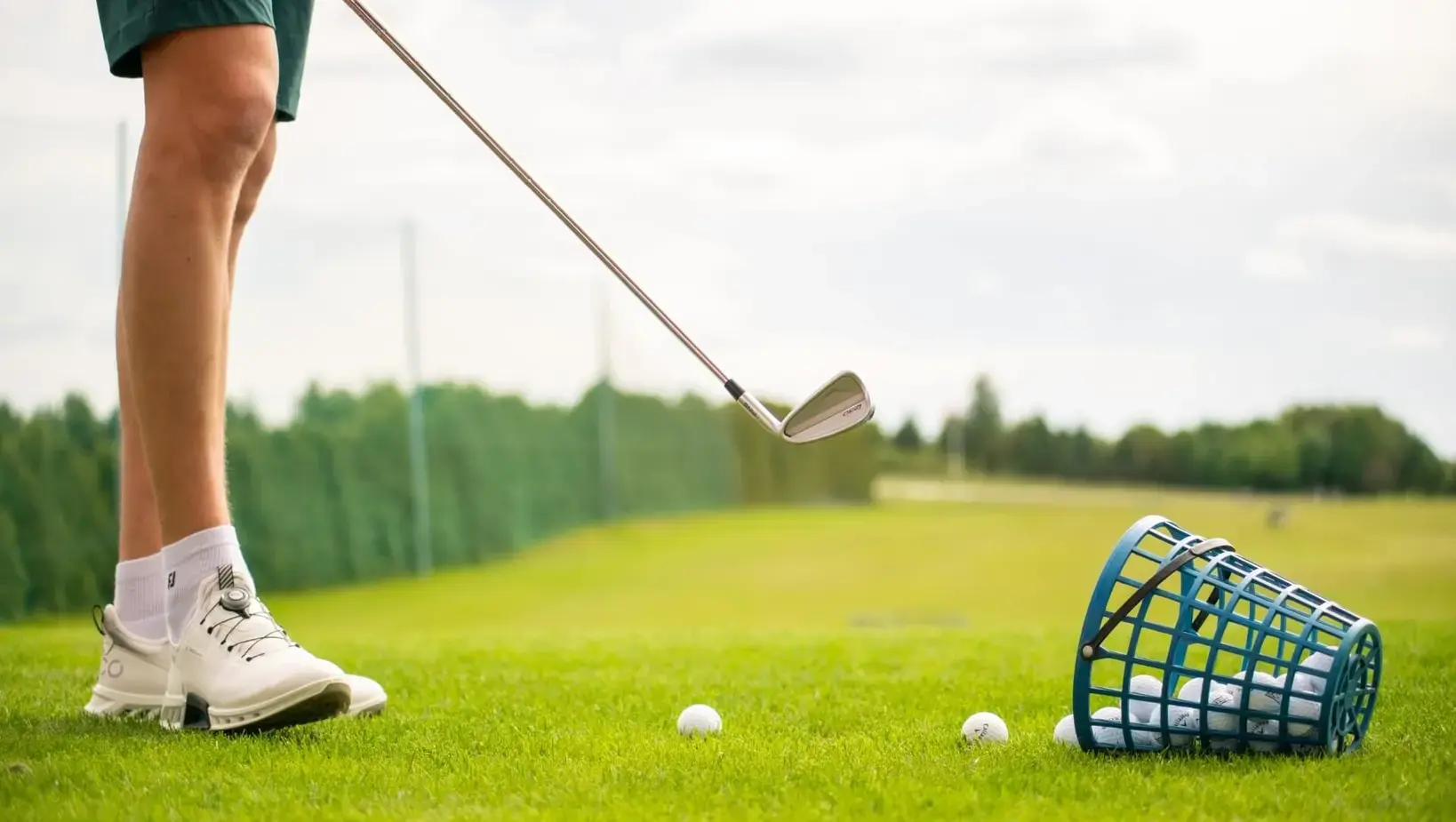
Five months off the course can mean a better swing
Across northern and central Europe the golf season ends with the first frosts, and most players will not play their next round on grass until April. Five months off is enough to lose your feel for the short game and the rhythm of your swing. It is also enough to come back in spring with a better swing than you had in autumn, as long as you go into winter with a plan.
This guide covers what works: how to use a simulator and read its data, how to practise chipping, pitching and putting at home, how to spread your training over the coming months and how to plan your return to the course.
What you lose over winter, and what you can gain
Distance control in the short game goes first. Your body remembers the full swing for a long time, but the feel for how hard to hit a fifteen-metre chip or an eight-metre putt fades quickly without contact with the ball. Next to go is rhythm, the tempo of the transition from backswing to downswing.
What you can gain is something the season leaves no room for: changing your technique. During the season every swing change shows up in your next round, so players keep putting it off. In winter there is no score, only the process. That is why bigger technical changes are best planned for the months without a course.
Golf simulators: what they are and what they actually measure
A golf simulator has two parts. The first is a launch monitor, a device that measures club and ball parameters at impact. The second is a projected virtual course that shows the ball flight. You hit a real ball with a real club from a mat towards the screen, and software calculates the rest of the flight.
One of the best-known brands in this category is Denmark's Trackman, whose devices were used for Poland's first national indoor golf championship. Whatever the brand, the numbers determine the value of the training. The course graphics are a bonus.
| Parameter | What it means | What to watch in winter |
| Club speed | speed of the clubhead at impact | a baseline, not worth forcing in winter |
| Ball speed | speed of the ball just after impact | rises with the quality of contact |
| Smash factor | ball speed divided by club speed | the best measure of clean contact; with a driver the upper limit is about 1.5 |
| Launch angle | the angle at which the ball takes off | look for consistency with each club |
| Spin | ball rotation in revolutions per minute | too much shortens your drives, too little makes it hard to stop the ball on the green |
| Carry | distance in the air to the first contact with the ground | the basis of your distance chart for every club |
| Attack angle | whether the club is descending or ascending into the ball | negative with irons; neutral or positive works better with the driver |
| Club path and face angle | direction of the club's movement and where the face points at impact | the relationship between the two decides whether the ball curves left or right |
Three traps of training off a mat
The mat is forgiving. A strike where the club hits the ground a few centimetres behind the ball ends in a noticeably shorter shot on grass. On a mat the club slides along the surface and the reading can look surprisingly good. That is why smash factor and strike location on the clubface matter more than distance alone.
A virtual round is entertainment. Playing a simulated course works well in a group, but over one round you hit dozens of shots with different clubs and no repetition. Changing your technique needs a series of the same shot with a clearly defined goal.
One parameter at a time. Trying to fix club path, attack angle and spin at the same time ends in chaos. Pick one metric a week and work only on that.
Indoor golf now has its own national championships
Poland's golf federation, Polski Związek Golfa, held the country's first Indoor Golf Championship in winter 2026, from 7 January to 15 March. Qualifying rounds were played on Trackman simulators with a Trackman Connect licence, at a venue and time chosen by each player. The finals were played live: amateurs in Łódź, the elite in Warsaw. More than 200 people took part, including 178 amateurs and 25 elite players, at 21 venues, and 3,949 rounds were started.
At the end of October 2026 the date of the next edition had not yet been announced. The very fact that a national federation runs indoor competition with separate age and handicap categories shows that indoor golf is no longer just a winter stand-in.
The short game in winter: chipping, pitching and putting
Par 72 assumes two putts on each of the 18 greens, which makes 36 putts. Half of a par score is putting, plus the shots from around the green. That is why in winter the short game gives the fastest return on practice time, and you can do most of the drills at home.
Chipping vs pitching: the difference
| Chipping | Pitching | |
| Distance | right next to the green | further out, usually from a dozen to several dozen metres |
| Ball flight | low, brief time in the air | high, longer in the air |
| Roll after landing | long | short |
| Swing | short, wrists almost still | longer, with wrist hinge |
| Typical club | wedge, but also a 7–9 iron | pitching wedge, sand wedge, lob wedge |
A simple rule: if you can roll the ball, chip it. Choose a pitch when there is an obstacle between you and the flag or too little green left to roll the ball on.
Putting on a mat: three drills
All you need at home is a mat three to four metres long.
- The gate. Place two tees just wider than the ball, about 30 centimetres in front of it on the putting line. The ball must pass through the gate without touching it. This trains starting the ball on your intended line.
- The distance ladder. Lay out three markers every one and a half metres. Each ball must pass the previous marker and stop before the next one. This trains distance control, the first thing to go in winter.
- The clock. Place four balls a metre from the hole, one on each side. A set counts only when all four drop in a row. This builds confidence on short putts.
Ten to fifteen minutes a day does more than two hours once a month.
Your winter plan: from November to the first round
An example split worth discussing with your coach:
| Period | Priority | Frequency |
| November–December | review the season, decide on technical changes, first sessions with a coach | 1–2 sessions a week |
| January–February | consolidate changes on a simulator or indoors, putting at home | 2 sessions a week + daily putting |
| March | distance chart for every club, short game with scoring | 2–3 sessions a week |
| April | back on grass: driving range, short game around the green, first rounds | weather permitting |
Your body has a season too
Winter is a good time to work on the mobility and strength golf demands: thoracic rotation, hip stability and core muscles. It does not have to be a specialist programme. Regular rotation and strengthening exercises twice a week make it easier to return to a full swing after a break. If you are coming back from an injury, plan your training with a physiotherapist.
Start next season on the Baltic coast
Winter work pays off most when it continues on grass in spring. At Sierra Golf Resort, on Poland's Baltic coast near Gdańsk, the 300-metre driving range with 26 covered bays is a good place to check whether your winter distance chart from the simulator matches real ball flight outdoors. The 18-hole, par 72 course is right next to it.
The resort's Golf Academy runs every Sunday of the season, whatever the number of participants. In 2026 it ran from 19 April to 30 September, with a junior group from 10:00 to 12:00 and an adult group from 12:30 to 14:30. Classes are led by Alvin Brasseaux, coach of Poland's national team from 1995 to 2001. The academy offer for 2026 (PDF in Polish) included:
- a package of ten training sessions with a Green Card exam: PLN 2,999 for adults and PLN 1,999 for juniors, with a one-course lunch at every session,
- an individual lesson for PLN 350,
- joining an academy group session for PLN 180.
Reception confirms prices and dates for the 2027 season.
If you are looking for a gift, the academy offers personalised golf lesson vouchers, valid for a full year according to the offer. For golfers who already play, there is the 18-hole green fee voucher, valid for 365 days from issue. For those who play all season, membership is worth comparing.
Frequently asked questions
Is training on a golf simulator worth it? Yes, if it has a clear goal. A simulator measures club and ball speed, launch angle, spin, carry, and club path and face angle, so you can work on technique with numbers. A mat forgives shots hit behind the ball, so clean contact is best judged by smash factor.
What is the difference between chipping and pitching? A chip is a low shot right next to the green: the ball spends little time in the air and rolls a long way. A pitch is a higher shot from further out: the ball stays in the air longer and stops more quickly.
Are there national championships in indoor golf? Yes. Poland's golf federation held its first national Indoor Golf Championship from 7 January to 15 March 2026 on Trackman simulators. More than 200 players took part at 21 venues.
How can I practise putting at home? On a mat three to four metres long. The three basic drills are a gate made of two tees in front of the ball, a distance ladder with markers every one and a half metres, and the clock, a series of short putts from four sides of the hole.
How much do golf lessons cost at Sierra Golf Resort? In the 2026 season, a package of ten training sessions with a Green Card exam cost PLN 2,999 for adults and PLN 1,999 for juniors. An individual lesson was PLN 350, and joining an academy group session PLN 180. Reception confirms prices for the 2027 season.
Plan your spring now
Get in touch if you would like to book a place at the academy for 2027, arrange an individual lesson or buy a golf lesson voucher. Winter is the time to plan. In spring all that is left is the training.